---
title: Where to Get Global Telecom Data
description: Learn where to get reliable, accurate data on the world's telecom markets, including mobile, fixed broadband, fixed voice subscriptions, and service providers.
image: https://www2.telegeography.com/hubfs/Dont%20automate%20your%20critical%20intelligence.png
---
[](https://www2.telegeography.com/?hsLang=en)
- [About](https://www2.telegeography.com/about-us)
- [Research](https://www2.telegeography.com/our-research)
- [Products](https://www2.telegeography.com/products)
- [Solutions](https://www2.telegeography.com/solutions)
- [Resources](https://resources.telegeography.com)
[Log In](https://www.telegeography.com/login/login?service=https%3A%2F%2Fwww.telegeography.com%2Faccount%2Fhome%2Findex)
[Contact](https://www2.telegeography.com/contact-us?hsLang=en)
###### Telecom research + AI
# For retail telecom data, you can't rely on AI alone
See the differences between AI search and GlobalComms Database.
***"Being completely honest, I could just get the AI to do it, but I feel like your database will be of better quality.”***
That’s a real quote from a prospective GlobalComms Database customer before they spoke with our team. It's true that AI has been a useful tool for work that involves research, planning, and strategy. But like all tools, there’s a sensible use for AI research—and there are cases in which AI isn't going to get the job done.
A hammer is a great tool for driving in a nail. But when you need to more firmly anchor to something, you’ll need a screwdriver and a screw.
The same is true for using AI tools to gather telecom data. AI is useful for quick, high-level hits, like a hammer. But when you need firmly anchored critical intelligence, you need something like a screwdriver—our **[GlobalComms Database](https://www2.telegeography.com/globalcomms-database-service?hsLang=en)**—yielding secure results you can count on.
**This page examines how AI compares to our GlobalComms Database. We’ll take a look at the types of information best suited for each platform, the accuracy of the results, and our suggestions for when to use AI and GlobalComms Database for your telecom market research.**
## Where AI gets telecom data
If you’re looking for a quick overview and background information on a market, AI is a useful way to get an idea of what’s going on there. But it’s a good idea to double check those findings, as AI often cites sources that are not authoritative and are out-of-date, incomplete, or just plain wrong.
AI platforms regularly rely on press releases for information and cite them at higher rates than many other source types. A press release can be useful for gathering information about a company’s major projects and investments, but it’s important to keep in mind that press releases are a marketing tool. They primarily serve the purpose of amplifying a company’s messaging and are not subject to a high level of scrutiny from outside sources.
AI tools are great at skimming the internet and sourcing data at lightning speed, but when it comes to telecom data, we often find that the articles cited by AI and fed into its answers are several years out of date—which means the facts, figures, and context to that information is also outdated.
And as people who’ve dedicated our careers to sourcing, collating, and analyzing telecom data, we’d be remiss if we didn’t mention AI’s tendency to hallucinate and make up wrong answers (and then backtrack when you call it out).
Let’s take a look at one example of how this plays out in market research.
## AI vs. GlobalComms example
We recently ran some tests to see if AI had captured data we recently collected. In this example, we wanted to test AI’s scope of reference and accuracy against our quarter-by-quarter data spanning more than a decade.
We told the AI:
#### ***I need to know about any changes in mobile market shares in Italy over the past decade.***
AI said:
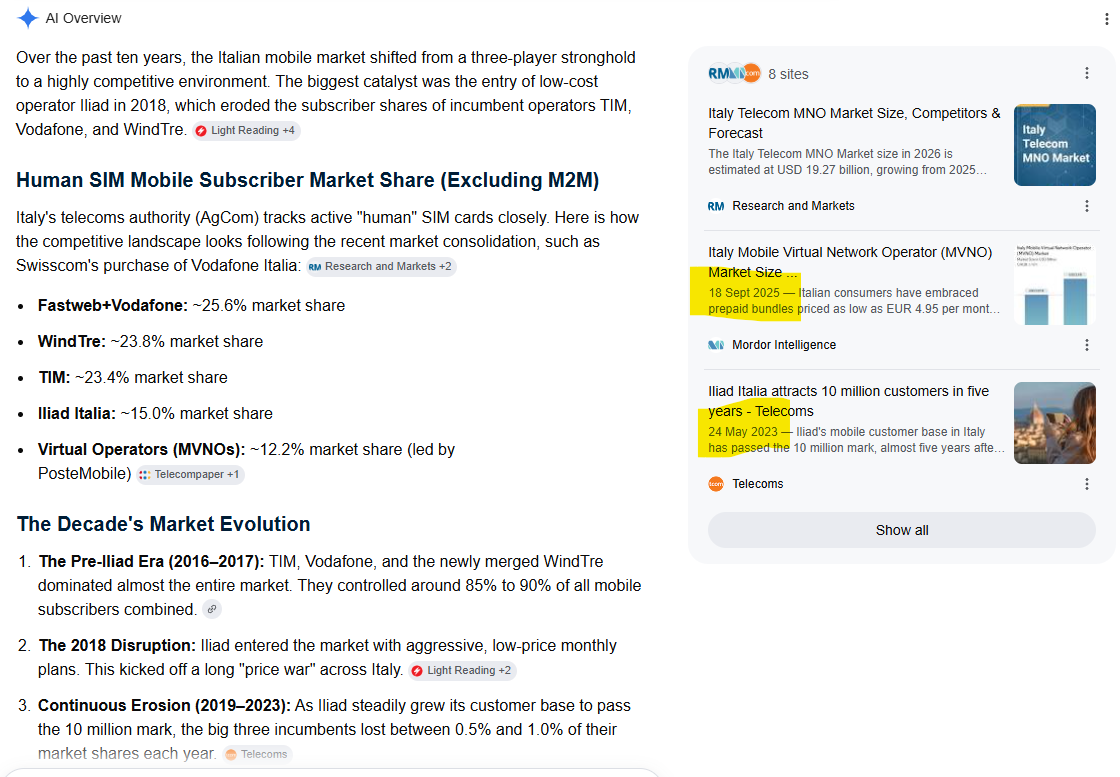
The AI noted, somewhat correctly, how Iliad entered the market in 2018 and has gone on to capture about 15% market share from its three rivals. It wasn’t totally wrong—Iliad actually reached 15% in 2025 and currently has more than 16% market share. This isn’t a huge margin, but it shows how using figures from articles that are nearly a year (or a few) old can skew the figures.
Depending on how you plan to use this data, this small margin might not make a cataclysmic difference for your work and its impact on your organization, but margins of error do compound and will certainly misdirect your forecasts, strategies, and investments.
You wouldn’t let AI steer your strategy. Don’t automate your critical intelligence.

Now let’s take a look at what this research looks like if you’re using GlobalComms Database instead of AI.
## GlobalComms Database: decades of telecom data
In contrast to the surface-level skim you get from AI, **[GlobalComms Database](https://www2.telegeography.com/globalcomms-database-service?hsLang=en)** will give you an exact market share for every operator for every single quarter going back decades to 2003.
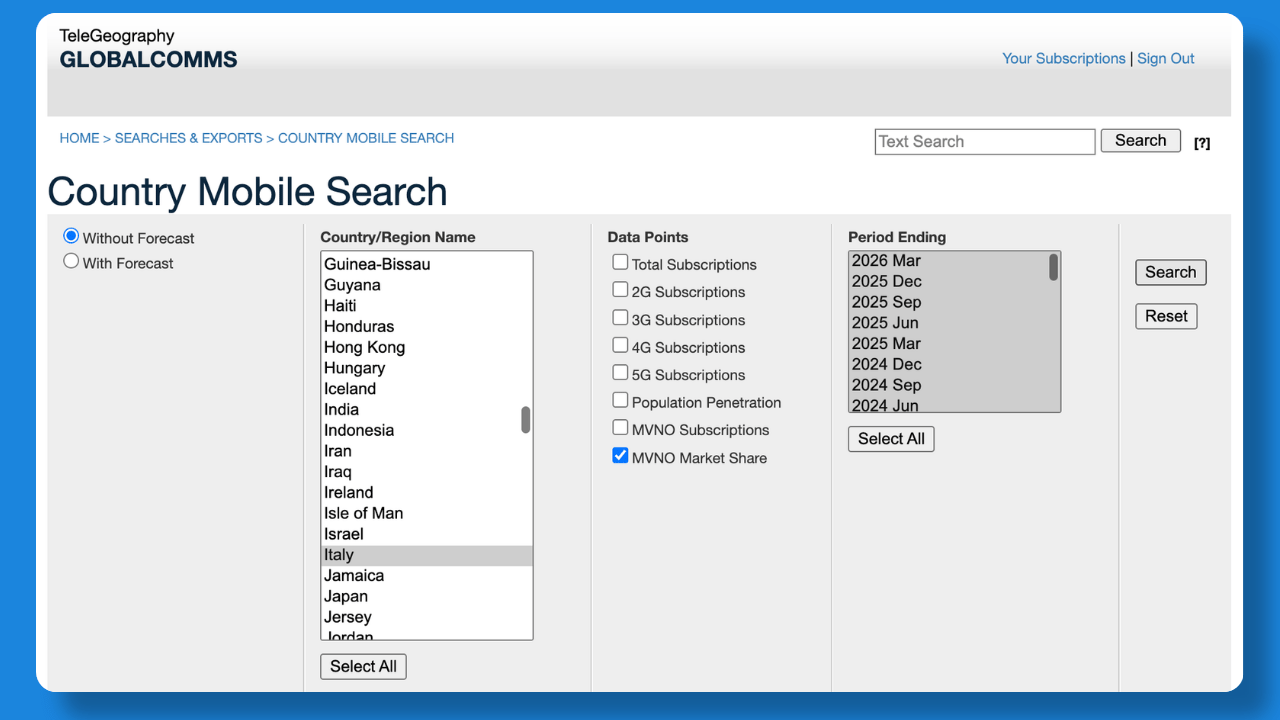
View data in the platform or export your search results as a downloadable spreadsheet.
While AI responses can rely on information from years-old press releases, GlobalComms is constantly being updated. Our GlobalComms research team spends around 10% of their day looking for news developments for the countries they cover, and all of this information goes straight into GlobalComms Database and is updated monthly.
And every month our team writes 250-300 news stories—curated, researched, and reported by our telecom experts—that are fed directly into GlobalComms and also made available through our daily CommsUpdate email.
.gif?width=600&height=338&name=Thumbnail%20Video%20and%20Blog%20(7).gif)
## How often are AI search platforms updated with new telecom data?
The short answer is: no one knows. The mechanisms behind AI search and retrieval are not yet clear. While we don’t currently understand how long it takes before an online source is updated and when AI finds and references new data in relevant answers, there’s one thing we know for sure:
### GlobalComms Database is updated monthly:
- Country profiles
- Company profiles
- 250-300 new, expert-written telecom news stories
Plus large annual updates for every data set.
So, while a few AI queries can give you a decent overview of a market, it is in no way backed up with the latest intelligence or the depth of research available in **[GlobalComms Database](https://www2.telegeography.com/globalcomms-database-service?hsLang=en)**.
## When to use AI and GlobalComms Database for your telecom market research
Don’t get us wrong—we’re not anti-AI. We're against bad data.
At TeleGeography, we’ve delivered the telecom industry’s most authoritative, unbiased data and analysis since 1989, so we know what reliable data looks like. We’ve made it our mission to make the most accurate and complete data available for anyone whose work intersects with telecommunications, and we don’t want to see you using bad data for your critical intelligence.
### Here’s how we recommend using AI for telecom research:
- Get an overview of market dynamics
- Identify the main players and trends in a market
### And then use GlobalComms Database to:
- Validate AI results
- Add depth and context to your research
- Explore historical and forecast data
- Understand the trends behind the numbers with analysis written by our global telecom experts
## Get real telecom data you can rely on—not AI hallucinations
You need accurate, timely, and complete intelligence you can bank your business on. TeleGeography's **[GlobalComms Database](https://www2.telegeography.com/globalcomms-database-service?hsLang=en)** delivers comprehensive data on mobile, fixed broadband, and fixed voice subscriptions, markets, and service providers around the world.
Learn how organizations like [Orange Wholesale](https://www2.telegeography.com/orange-wholesale-case-study?hsLang=en) and the [European Commission](https://www2.telegeography.com/the-european-commissions-data-backed-approach-to-international-policy?hsLang=en) use TeleGeography's GlobalComms Database for their critical intelligence.
[](https://www2.telegeography.com/orange-wholesale-case-study?hsLang=en)
### [Orange Wholesale case study](https://www2.telegeography.com/orange-wholesale-case-study?hsLang=en)
[](https://www2.telegeography.com/the-european-commissions-data-backed-approach-to-international-policy?hsLang=en)
### [European Commission case study](https://www2.telegeography.com/the-european-commissions-data-backed-approach-to-international-policy?hsLang=en)
## Let's get you the (real) data you need
What else do you need to know about our retail insights?
Ask us here. We aim to respond via email within one business day. Fill out the form and we'll be in touch soon.
[](https://www2.telegeography.com/?hsLang=en)
[Login](https://www.telegeography.com/login/login?service=https%3A%2F%2Fwww.telegeography.com%2Faccount%2Fhome%2Findex)
[Contact Us](https://www2.telegeography.com/contact-us?hsLang=en)
###### [About](https://www2.telegeography.com/about-us?hsLang=en)
- [Research](https://www2.telegeography.com/our-research)
- [Products](https://www2.telegeography.com/products)
- [Solutions](https://www2.telegeography.com/solutions)
- [Demo](https://www2.telegeography.com/demo)
###### [Press](https://www2.telegeography.com/telegeography-press?hsLang=en)
- [Events](https://www2.telegeography.com/telecom-events)
- [Careers](https://www2.telegeography.com/careers)
###### [Resources](https://resources.telegeography.com/?hsLang=en)
- [Podcast](https://www2.telegeography.com/telegeography-explains-the-internet-podcast)
- [Newsletter](https://www2.telegeography.com/subscribe-to-telegeography-emails)
-
-
All Rights Reserved 2026
- [Privacy Policy](https://www2.telegeography.com/privacy-policy)
```json
{
"@context" : "https://schema.org/",
"@type" : "WebSite",
"image" : "https://www2.telegeography.com/hubfs/Website/assets/logo/telegeography-logo.svg",
"name" : "GlobalComms + AI",
"potentialAction" : {
"@type" : "SearchAction",
"query-input" : "required name=search_term_string",
"target" : "{search_term_string}"
},
"url" : "https://www2.telegeography.com/where-to-get-global-telecom-data"
}
```